
The Cross Mark Emoji ❌ is a simple yet powerful symbol used to show rejection, mistakes, wrong answers, or something that is not allowed.
If you are chatting with friends, sharing social media posts, or creating fun messages, this emoji helps express your thoughts quickly.
Its bold red appearance makes it easy to notice and understand in everyday digital conversations.
You can use the cross mark emoji on WhatsApp, Instagram, TikTok, and other platforms to highlight incorrect information, cancel plans, or show disagreement.
It can also add clarity to lists, quizzes, captions, and comparisons. Understanding its meaning helps you use ❌ naturally and effectively in your messages.
What do cross mark emoji mean?
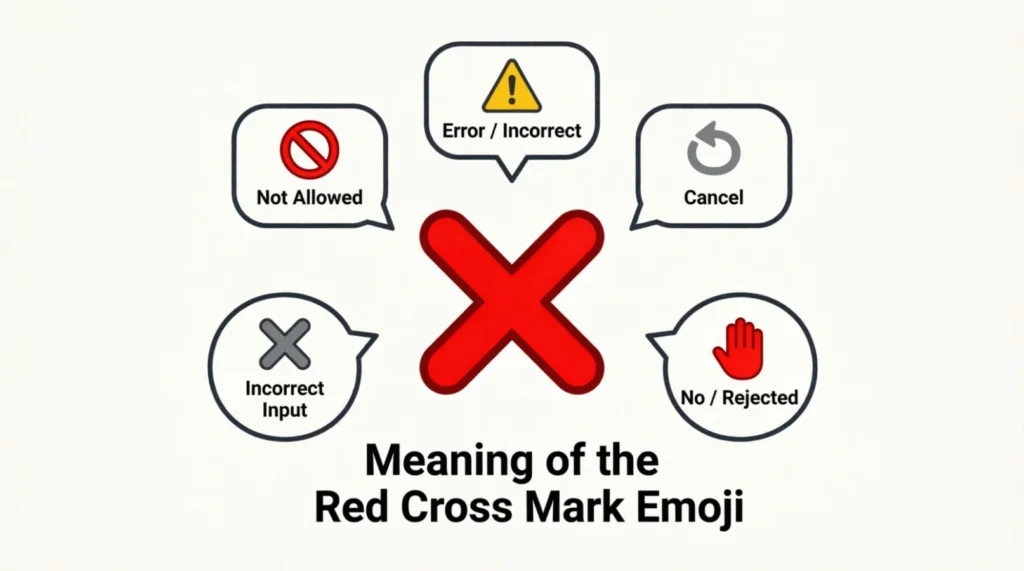
The cross mark family is mainly connected with rejection, mistakes, cancellation, correction, or something being unavailable. The exact tone depends on the symbol and the sentence around it.
A bold ❌ can feel like a firm “no,” while ✖️ may look more neutral or decorative. Symbols such as ☒ can suggest something has been marked or selected incorrectly.
| Emoji | Core meaning | Misread as | Best used when |
| ❌ | No, wrong, rejected | Anger | Rejecting or correcting something |
| ❎ | Incorrect or negative choice | Harsh criticism | Marking an option as wrong |
| ✖️ | Cross, cancellation, multiplication | Decorative symbol | Casual text or visual emphasis |
| ✕ | Simple cross or rejection | Typing symbol | Minimal captions or notes |
| ⨯ | Strong crossed mark | Mathematical symbol | Clear visual emphasis |
| ☒ | Checked-off negative option | Checkbox | Lists, choices, or corrections |
| ☓ | Crossed symbol | Decorative mark | Short messages and notes |
| ╳ | Large crossed mark | Design element | Visual emphasis |
| 🚫 | Not allowed or prohibited | General “no” | Rules and restrictions |
| ⛔ | Stop or do not proceed | Traffic symbol only | Warnings and firm boundaries |
❌ Red Cross Mark
Meaning: Rejection, incorrectness, refusal, or a clear “no.”
Example 1: That answer is wrong ❌
Example 2: Not happening today ❌
❎ Cross Mark Button
Meaning: A negative choice, incorrect option, or rejected selection.
Example 1: Choose the correct answer ❎
Example 2: That option is out ❎
✖️ Multiplication X
Meaning: A cross symbol commonly used for cancellation, separation, or visual emphasis.
Example 1: Plans cancelled ✖️
Example 2: Deal closed ✖️
✕ Cross
Meaning: A simple crossed symbol used for rejection or visual separation.
Example 1: Maybe later ✕
Example 2: Try again ✕
⨯ Crossed Multiplication
Meaning: A strong X-shaped mark used for emphasis or correction.
Example 1: That choice is not right ⨯
Example 2: Entry denied ⨯
☒ Ballot Box With X
Meaning: A marked checkbox representing a selected or rejected option.
Example 1: Not selected ☒
Example 2: Remove this choice ☒
☓ Saltire Cross
Meaning: A crossed mark that can visually indicate rejection, separation, or cancellation.
Example 1: Keep this one out ☓
Example 2: Cancel that idea ☓
╳ Crossed Lines
Meaning: A bold visual X used to emphasize something crossed out or stopped.
Example 1: Wrong direction ╳
Example 2: Access closed ╳
🚫 Prohibited
Meaning: Something is forbidden, restricted, or not permitted.
Example 1: No shortcuts 🚫
Example 2: Phones here 🚫
⛔ No Entry
Meaning: A strong warning to stop, avoid, or not continue.
Example 1: Do not enter ⛔
Example 2: Stop right there ⛔
How to use cross mark emoji the right way
On WhatsApp, cross marks work especially well in personal conversations because they make quick reactions obvious. You can use them when declining plans, correcting a statement, or jokingly rejecting an idea.
For example, “Movie tonight? ❌” feels much more expressive than simply saying “no.” In a close conversation, the same symbol can also make playful teasing easier to understand.
On Instagram, these symbols can have a more visual role. Creators may use them in captions, carousel text, polls, product-related posts, or before-and-after comparisons. Keeping the usage consistent can make a caption feel cleaner and easier to scan.
On TikTok, cross marks often fit short, humorous, ironic, or reaction-based content. A creator might place one after an obviously bad decision or use a short combination to make a punchline more noticeable.
Do:
- Use a cross when your intended “no” or rejection is obvious.
- Match the symbol with the seriousness of your message.
- Keep combinations short when writing captions.
- Use copy-paste emojis when you want quick visual emphasis.
Don’t:
- Add several crosses when one already makes your point.
- Assume every cross has exactly the same tone.
- Use a strong rejection symbol when a softer response would be better.
- Fill professional messages with repeated symbols.
Best cross mark emoji combos copy & paste
These combinations keep the focus on the same cross-related family while giving you ready-to-use options for chats, captions, and comments.
Romantic
- ❌❤️ Not saying no to you
- ✖️❤️ Love wins, bad vibes out
- ❎❤️ Choosing love, rejecting drama
Cute
- ❌☒ Nope, not this one
- ✕❎ Cute little rejection
- ☓❌ That idea is officially out
Flirty
- ❌✖️ Trying to resist you
- ✕❤️ Maybe my “no” means something else
- ❎✕ Acting difficult on purpose
Missing someone
- ❌❤️ No day feels complete without you
- ✖️☓ Missing you, and nothing feels right
- ❎❤️ Rejecting every plan except seeing you
Good night
- ❌⛔ No more scrolling tonight
- ✕🚫 Phone down, sleep mode
- ❎⛔ Day officially finished
Trending cross mark emoji in 2026
Cross-related symbols continue to fit the fast, visual style of online communication because they communicate a reaction without requiring a long explanation. In 2026, their usefulness is especially noticeable in short captions, reaction posts, casual chats, and humorous content.
❌ remains a natural choice when someone wants a highly recognizable visual “no.” ✖️ works nicely when a creator wants a cleaner symbol, while ❎ can fit lists, choices, and reaction-style content.
Younger users and content creators often mix these symbols with short phrases rather than writing a complete explanation. WhatsApp and TikTok are particularly suitable for quick reactions, while Instagram can use them as part of caption styling and visual text.
| Emoji | Why trending | Who uses it | Platform |
| ❌ | Instantly recognizable reaction | Everyday users, creators | WhatsApp, Instagram, TikTok |
| ✖️ | Clean and flexible visual style | Creators, casual users | Instagram, TikTok |
| ❎ | Useful for choices and reactions | Students, creators, chat users | WhatsApp, TikTok |
| ✕ | Minimal and aesthetic appearance | Caption writers, creators | Instagram, WhatsApp |
Emoji communication generally continues to evolve alongside changing online styles, with familiar symbols gaining new tones through context and creative combinations.
FAQs:
1. What is the most popular cross mark emoji?
❌ is one of the most recognizable cross-related emojis because it clearly communicates rejection, incorrectness, or “no” at a glance. It works naturally in everyday digital conversations.
2. What does ❌ mean from a girl or boy?
The meaning usually depends more on the conversation than the sender’s gender. It can indicate “no,” disagreement, rejection, cancellation, or playful refusal.
3. Why do emojis look different on iPhone vs Android?
Emoji designs are created and displayed through platform-specific fonts and software. The same Unicode emoji can therefore have different shapes, sizes, or visual details across devices.
4. Are cross mark emoji used differently in other countries?
The basic ideas of rejection and cancellation are widely understood, but local communication habits can change the tone. Context remains important when interpreting emojis internationally.
Conclusion
The cross mark emoji family makes digital communication faster, clearer, and more expressive.
If you’re rejecting an idea, adding personality to a caption, or creating a quick reaction, the right symbol can make your message instantly understandable.
Use it naturally, match it to your tone, and let the surrounding words provide the context.